
Category: Lifestyle

Discover lifestyle stories and inspiration for everyday life. Explore personal style, thoughtful routines and ideas that complement your fashion and beauty interests.

  • Autumn Wardrobe Reset: Make Your Existing Clothes Work Harder

    Autumn Wardrobe Reset: Make Your Existing Clothes Work Harder

    An autumn wardrobe reset is a chance to make your clothes easier to use before deciding what to buy. You do not need to empty the entire wardrobe, replace every summer piece or follow a complete trend list. Begin with the outfits that fit your current weather, work and everyday plans.

    The change of season often brings new colour and layering ideas, but the useful question is what your own clothes can already do. This guide offers a practical sequence: review, try combinations, solve small problems and make a short list of real gaps. The result should be more wearable outfits, not simply a tidier wardrobe photograph.

    Start with the week you actually live

    Write down your usual activities: work, errands, time at home and any regular social plans. Note how much walking, commuting or outdoor time they involve. A wardrobe should support those situations before it supplies occasional outfits that rarely leave the hanger.

    Look at the weather where you live rather than a seasonal image from another country. Autumn may mean cool mornings, continued heat or changing rain. That affects fabric weight and layering. The right reset is based on your conditions, not a compulsory collection of coats and heavy knits.

    Choose a small area to review first

    Start with one useful category, such as trousers, tops or outer layers. A manageable section is easier to finish and gives you a clear result. Pulling every item out at once can turn a simple review into a long task you abandon halfway through.

    Keep a place for pieces that need trying on or repairing. Do not immediately label everything unworn as unwanted. Some clothes may simply need a better combination, an alteration or a change in storage so you remember they exist.

    Try the dependable pieces together

    Choose the jeans or trousers you wear most often, then test them with three tops and one outer layer. Add the shoes you would actually use. Judge the whole combination rather than assuming that individual pieces will work because they look attractive on their own.

    Our capsule wardrobe guide explains how to build around repeatable basics. You do not need to adopt a strict capsule count. Use the idea to identify the clothes that support several ordinary outfits.

    Check fit before blaming the style

    A hem that drags, a sleeve that feels too long or a waistband that pulls can make a useful garment seem wrong. Try the piece while sitting and walking, then identify the specific problem. A small alteration may improve it more than buying something similar.

    Be realistic about what can be repaired or changed. Ask a suitable professional if the garment is important to you. Do not keep a large pile of imagined alterations indefinitely; choose the repairs you will actually arrange and set the rest aside for a later decision.

    Use light layers for changing temperatures

    A shirt, cardigan or jacket can make clothes useful across different parts of the day. Test whether the layers fit comfortably together and whether you can remove one without leaving an outfit you dislike. Flexibility is more practical than simply wearing more pieces.

    Look at cuffs and collars, where layers often become crowded. A thinner base can help beneath a structured jacket. If the top has fuller sleeves, choose an outer layer with enough room. Comfort while moving is as important as the front view in a mirror.

    Add one seasonal idea at a time

    Choose a colour, texture or accessory that appeals to you. You might try a richer bag colour, a printed scarf or a different denim combination. Keep the rest of the outfit familiar so the new detail is easy to assess.

    Our burgundy outfit guide and autumn scarf ideas offer small changes you can make with existing basics. A seasonal refresh does not need every current trend in one outfit.

    Make a repair and care list

    Inspect the pieces you want to use for missing buttons, loose hems, worn soles or stains that need appropriate treatment. Read care labels before washing or steaming. A useful garment can remain unworn simply because a small maintenance task was never completed.

    Keep the list short and actionable. Arrange one repair or cleaning task, then return the garment to the active wardrobe. This creates a visible benefit and prevents the reset becoming only an exercise in moving clothes from one pile to another.

    Store clothes so outfits are easier to see

    Keep frequently used pieces accessible and group them in a way that supports your decisions. You might arrange by garment type or by the outfits you repeat. There is no universal system; choose one that helps you find what you need without digging through unrelated items.

    Move unsuitable seasonal pieces elsewhere if space is limited, but keep flexible basics visible. A tee or light shirt may still be useful under a layer. Do not hide every summer item automatically just because the calendar changed.

    Photograph combinations worth repeating

    Take simple pictures of the outfits you like, including the footwear and bag. Save them together so a rushed morning does not require you to remember every successful combination. Add a short note if the outfit suits a particular temperature or activity.

    Photographs also reveal repeated problems. If every outfit feels incomplete because you lack one practical layer, that is a clearer shopping gap than a general desire for new clothes. Use the evidence from your own wardrobe before browsing long recommendation lists.

    Build a focused shopping list

    Describe the missing function before naming a product. You may need a light outer layer that fits over a knit, trousers suitable for work or shoes comfortable for a longer walk. Those descriptions guide the purchase better than a vague search for autumn essentials.

    Check whether the new piece can work in at least a few combinations you have already tried. Consider care, comfort and budget as well as appearance. A purchase is useful when it joins the wardrobe smoothly rather than creating a need for several more purchases.

    Autumn wardrobe reset checklist

    • Describe your actual weekly activities.
    • Review one garment category at a time.
    • Try complete outfits with suitable shoes.
    • Identify fit and repair problems.
    • Add one seasonal detail if you want it.
    • Photograph the combinations that work.
    • Shop only for clear gaps.

    You can complete the process over several short sessions. A finished review of one useful area is better than an ambitious plan that leaves the entire wardrobe on the floor. Keep each stage small enough to produce an outfit you can wear.

    Frequently asked questions

    Should I remove everything I have not worn recently?

    Not automatically. Ask why it was unworn. The season, fit, care requirements or lack of a useful combination may explain it. Try a practical solution where appropriate, then decide whether the piece still suits your life instead of applying one rigid time rule.

    Do I need to buy new colours for autumn?

    No. You can enjoy the clothes you already own and add a small detail only if you want it. A printed scarf, a different layer or a new pairing may create enough variety without a major purchase.

    For current seasonal context, see Vogue’s autumn colour report. Use the ideas selectively and let your own wardrobe, climate and daily routine decide what is worth trying.
  • Travel Beauty Kit: Pack a Small Routine You Can Maintain

    Travel Beauty Kit: Pack a Small Routine You Can Maintain

    A travel beauty kit should make your routine easier away from home, not reproduce every product on your bathroom shelf. Pack the care steps and makeup you actually use, with enough flexibility for the plans you have. A smaller kit is useful when you can find each item, store it properly and maintain it during the trip.

    The most common packing mistake is preparing for every imaginary occasion while ignoring ordinary days. Begin with the trip length, climate and activities, then choose familiar products. This guide focuses on practical organisation, clean tools and manageable routines rather than a compulsory list of miniature products.

    Build the kit around your itinerary

    Write down what the trip involves. A relaxed stay, a work visit and an event weekend may need different makeup options. Note how much outdoor time you expect and whether you will have access to a comfortable place to get ready.

    Think about luggage and transport too. If you are flying, check the current liquid and baggage rules for your airports and airline before packing. Do not rely on an old social media list, because the applicable requirements can differ by route and security equipment.

    Separate daily care from occasional makeup

    Put the products needed every day in one group, then add makeup for specific plans. This prevents a party lip or elaborate eye palette from crowding the basic routine. You can bring a special item without making the entire kit more complicated.

    Our beauty capsule guide helps identify the products you repeat. Use those as the starting point. Travel is usually not the most convenient time to test several unfamiliar formulas when your schedule and surroundings have already changed.

    Keep the skincare routine understandable

    Pack the care steps you know and use according to their instructions. Avoid adding a new routine simply because travel sized products are available. Any prescribed treatment should remain part of the plan as advised by your clinician, with suitable storage and enough supply.

    Our skinimalism guide explains how to review optional steps. If a product has no clear role in the trip, it may not need to come. A manageable routine is easier to maintain when you are tired or getting ready in an unfamiliar space.

    Plan sun protection for the activities

    Think about outdoor walks, sightseeing or time near water. Pack suitable sunscreen and follow its label, including reapplication and storage guidance. Shade and protective clothing should be part of the plan rather than treating one morning application as complete coverage for the day.

    If you wear makeup, choose a routine that leaves you willing to maintain sun protection. Our sunscreen under makeup guide discusses practical layering and planning. The cosmetic finish should not make an important care step too inconvenient to repeat.

    Choose makeup that supports more than one look

    A familiar base, one cheek colour and a dependable lip can cover ordinary days. Add a stronger lip or a small eye option if your plans justify it. You do not need several products that create almost the same effect.

    Only use products for purposes permitted by their instructions. A lipstick is not automatically suitable for eyes or every other area. Multi use packaging can be convenient, but read the intended uses rather than assuming that every creamy product can replace several categories.

    Reduce the tool collection

    Bring the clean tools your chosen products actually need. If your ordinary look uses one base tool and a small cheek brush, there is little reason to pack a large brush roll. A smaller set is easier to maintain and less likely to remain damp in a closed case.

    Plan how the tools will dry after cleaning. Give them ventilation where appropriate and avoid sealing a damp sponge in a pouch. Our makeup brush care article explains the basic storage decisions that help keep a kit manageable.

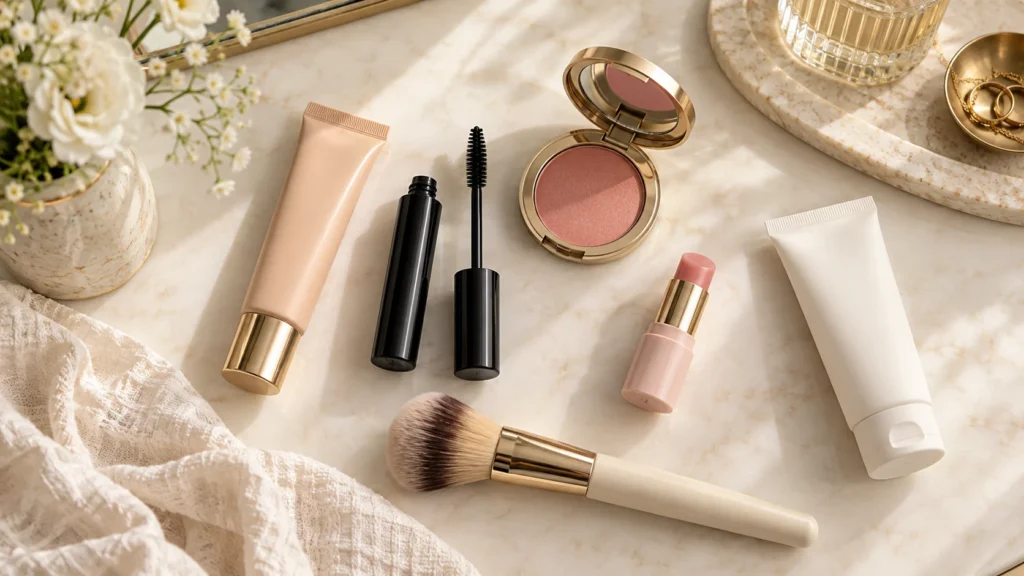
    Overhead flat lay of a small curated beauty capsule: one unlabelled tinted base tube, mascara, blush compact, lip balm, a brush and simple skincare tube, neatly arranged on an ivory vanity.

    Check containers before packing

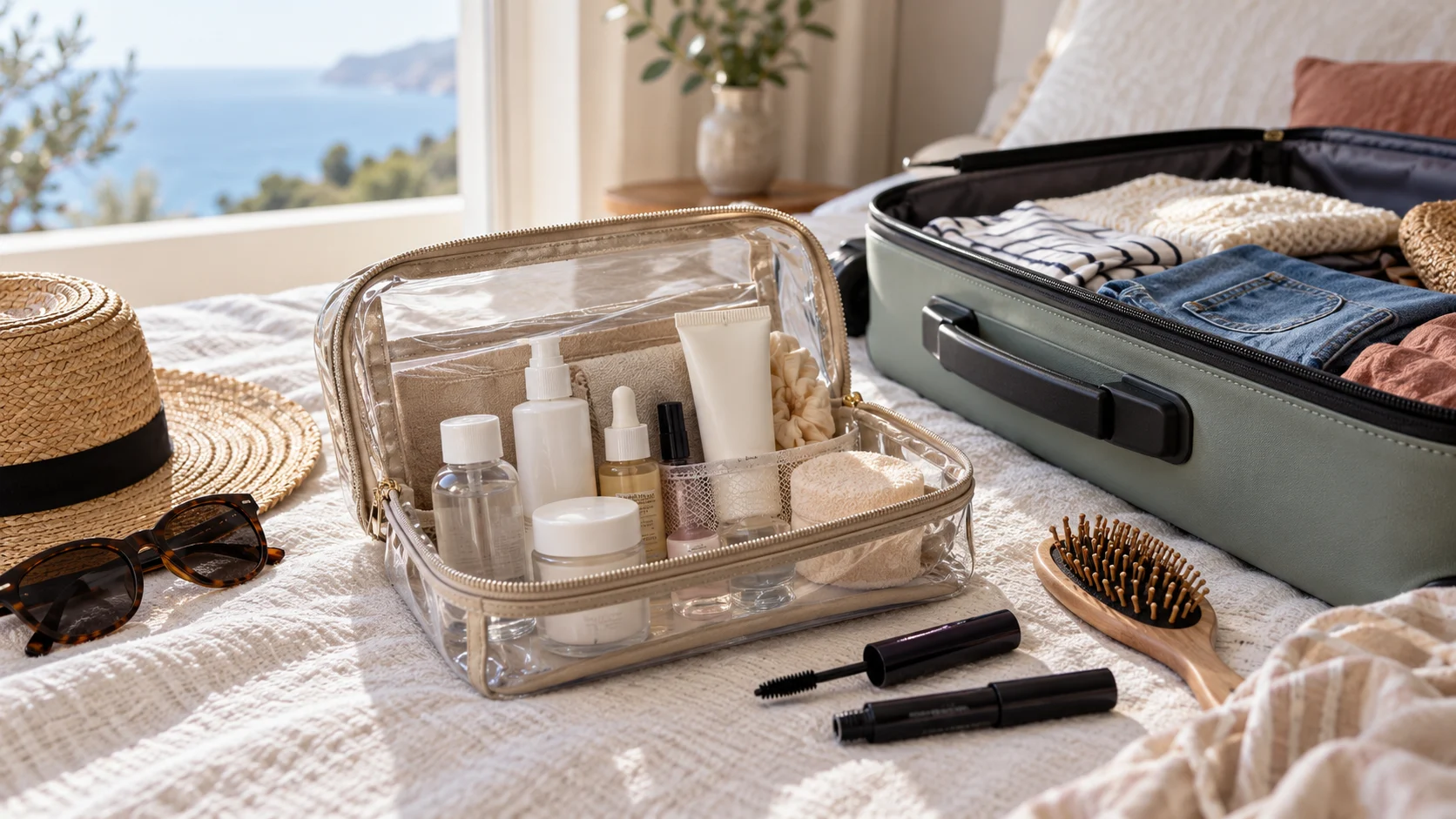
    Close every lid properly and inspect pumps, caps and seals. Keep products in suitable containers and follow storage instructions. Do not move sunscreen or other products into an unmarked container simply to make the kit look uniform without checking whether that is appropriate.

    If you use permitted travel containers, label them clearly and avoid mixing formulas. You should be able to identify the product and follow its instructions away from home. A matching set of tiny bottles is less useful than knowing exactly what you packed.

    Use pouches according to function

    A simple separation between daily care, makeup and tools can make the kit easier to use. The pouches do not need to be expensive, but they should be clean and suitable for the contents. Keep products that may leak contained so they do not cover every brush or accessory.

    Avoid packing the bag so tightly that you cannot remove one item without emptying everything. Leave enough room to put products away neatly. A kit that is organised only at home may become frustrating after the first morning of the trip.

    Test the packed routine before you leave

    Use the selected kit for one ordinary morning and evening at home. Notice whether an essential step is missing or whether several products are unnecessary. This is a more useful test than deciding from a flat lay photograph.

    Try the makeup look you plan for an event too. If it needs tools you did not pack, simplify the look or add the specific tool. Do not bring a large extra collection just because one technique might require something different.

    Keep a small refresh pouch

    For a long day, you may want a lip product, an appropriate mirror and the items needed for your planned care steps. Choose according to the day’s activities. A refresh pouch should be smaller than the main kit, not a second complete version of it.

    Check the items at the end of the day and return anything that needs cleaning or replacement to the right place. Small habits prevent the kit becoming a mix of clean and used tools, loose products and forgotten receipts.

    Travel beauty kit checklist

    • Confirm current transport and baggage requirements.
    • Pack familiar products with clear purposes.
    • Include required care and any prescribed items as advised.
    • Plan sun protection for outdoor activities.
    • Bring only the tools your makeup needs.
    • Check labels, lids and storage instructions.
    • Test the packed routine once at home.

    For flights involving the United States, the TSA liquid guidance is one official reference. Use the relevant official airport and airline information for your actual route rather than assuming one country’s rules apply everywhere.

    Frequently asked questions

    Should I buy a complete travel sized skincare set?

    Only if the products suit your needs and you understand the routine. Familiar products in appropriate packaging may be more practical. A set is not automatically useful simply because every item is small or comes in a matching pouch.

    What if I want a different makeup look every evening?

    Choose a small range of colours or finishes that can change the mood while keeping the base routine stable. A different lip or one eye detail can provide variety. Pack for the looks you will genuinely practise and wear, rather than every possible occasion.

  • Getting Ready Routine: A Calm Plan for Busy Mornings

    Getting Ready Routine: A Calm Plan for Busy Mornings

    A getting ready routine works best when it reduces decisions rather than adds rules. You do not need a long sequence of perfect habits before leaving home. A dependable outfit, a manageable beauty kit and a realistic order of tasks can make an ordinary morning feel less rushed.

    The useful starting point is your actual schedule. Notice where time disappears: searching for clothes, changing an outfit repeatedly, finding a missing brush or trying an unfamiliar makeup technique. This guide helps you build a routine around those practical problems, with room for different days instead of one rigid version.

    Observe a normal morning before changing it

    Choose an ordinary day and note what you do between waking and leaving. You do not need precise tracking for every minute. Write down the moments when you pause, search for something or repeat a task because the first attempt did not work.

    Look for patterns rather than blaming yourself for being disorganised. A missing item may need a better place to live. An outfit that takes several tries may need a saved combination. A routine becomes easier when the environment supports it, not when every step depends on extra willpower.

    Decide what is essential for leaving comfortably

    Separate the things you genuinely need from optional additions. Dressing appropriately, following your care needs and carrying required items belong in the essential group. An elaborate eye look or trying a new hairstyle may be enjoyable without being necessary every morning.

    Keep prescribed treatments or other professional advice outside ordinary routine cuts. Follow the instructions you have been given. The aim is to simplify optional decisions, not to remove important care because it takes more time than a beauty trend suggests.

    Prepare one dependable outfit in advance

    Choose an outfit that suits the next day’s weather and plans, then check the shoes and outer layer. Put the pieces where you can reach them. This is more useful than selecting only a top and leaving the rest of the combination unresolved.

    Our wardrobe reset guide explains how to build and save practical combinations. Keep two or three reliable alternatives available so a change in weather does not force you to restart the whole decision in the morning.

    Keep the beauty kit visible and limited

    Place the products you use daily together and move occasional items elsewhere. You should be able to identify the next step without comparing several similar products. A smaller visible area can help even if you enjoy a larger collection as a hobby.

    Our beauty capsule routine provides a way to organise by function. Keep care and makeup understandable rather than turning every product on the shelf into a compulsory step. Optional colour can stay available without slowing the ordinary routine.

    Build a simple makeup version first

    Choose the look you can comfortably repeat with familiar products and clean tools. It may involve concealer, a little cheek colour and a lip product, or another combination that suits you. There is no requirement to use a full base or several eye shades.

    Our natural makeup tutorial offers a starting point. Once the simple version is dependable, create an expanded version for days when you have more time. You will then know what can be added without rebuilding the entire process.

    Give hair a realistic plan

    Decide whether the morning calls for styling, a simple arrangement or using the shape already in your hair. Keep suitable accessories where you can find them. A clip you know how to use is more practical than an elaborate method you only watched once.

    If you want to learn a new technique, practise when you are not about to leave. Our heatless waves guide explains how to test a method and adjust it gradually. A busy morning should use the version you understand, not become the first trial.

    Put tasks in a useful order

    Overhead flat lay of a small curated beauty capsule: one unlabelled tinted base tube, mascara, blush compact, lip balm, a brush and simple skincare tube, neatly arranged on an ivory vanity.

    Some steps are easier when done before dressing, while others make sense afterwards. Choose an order that suits your products, clothes and available space. Avoid copying a routine that requires facilities or time you do not have.

    Consider where waiting naturally fits. If a product needs time according to its instructions, use that interval for another task instead of rushing the next layer. Keep the order simple enough to remember without an elaborate chart. The purpose is a smoother morning, not another item to manage.

    Create a shorter version for rushed days

    A routine needs a fallback. Decide which optional steps can be reduced and which essentials stay. That might mean a simpler lip, no detailed eye look and an outfit you already photographed. Planning the shorter version makes it easier to use without feeling that the morning has failed.

    Keep the fallback genuinely manageable. If it still asks for several unfamiliar techniques, it is not a useful alternative. Try it once on a normal day so you know how it feels and whether any necessary item is missing.

    Put leaving essentials in one place

    Choose a consistent place for the bag, keys and other items you need. Pack what can be prepared in advance. This prevents the final few minutes from becoming a search through rooms after the clothes and makeup are already finished.

    Check the next day’s specific requirements, not only the usual items. A work document, appointment information or weather appropriate accessory can easily be forgotten if the routine relies entirely on memory. A short list near the bag can help without creating a complicated system.

    Keep maintenance separate from the morning

    Brush cleaning, garment repairs and sorting old products are useful tasks, but they do not need to happen while you are trying to leave. Set aside another time for them so the everyday routine uses clean, ready items.

    Our brush care guide can help you plan tool maintenance. A clean tool available in the morning reduces the temptation to improvise with something unsuitable or add a new purchase because the existing item was never prepared.

    Review what worked after a week

    Notice which changes genuinely helped. You may find that preparing shoes mattered more than laying out makeup, or that moving one product saved repeated searching. Keep those improvements and remove steps that created work without a clear benefit.

    Do not judge the routine by whether every morning looks identical. Plans change and some days remain rushed. A good routine gives you dependable options and makes recovery easier, rather than demanding perfect performance before you can begin the day.

    Getting ready routine checklist

    • Prepare a complete outfit, including shoes.
    • Keep daily beauty products together.
    • Use a familiar makeup and hair version.
    • Plan a shorter routine for rushed days.
    • Put leaving essentials in one place.
    • Maintain tools and clothes at another time.

    You can build the system gradually. Solve the most repeated problem first and observe the difference before adding another habit. A useful routine is often a few small changes that fit your life, not a long list borrowed from someone else’s morning.

    Frequently asked questions

    How early should I start getting ready?

    Base it on your own tasks and travel needs. Observe the routine, allow room for ordinary interruptions and adjust from there. A universal time estimate is less useful than knowing which steps you actually repeat and how long your departure process usually takes.

    What if I enjoy spending longer on beauty?

    Keep an extended version for days when you want it. Enjoyment is a valid reason to use more time, as long as the routine fits your plans. The shorter version is an option for busy days, not a rule that every morning must be minimal.